
American Jobs
What I learned working in a frozen storage warehouse

It has come to my attention that Substack has inserted an AI-generated voiceover without my knowledge or permission, and I can’t seem to remove it. If you wish to listen to this story in MY voice, please select the audio option directly above this text.
In the warehouse parking lot where we all congregated for lunch, Brandy leaned against my car and took a drag of her cigarette. Her long, burgundy-dyed hair pooled on the white hood of my 1987 Toyota Camry like a puddle of blood.
“Look at this,” she said, gesturing to our coworkers who sat eating tamales on curbs and car hoods. Tattoos crept up her thick arms into the sleeves of her faded black t-shirt and wound through her collar, up her neck. Brandy seemed about as enthralled with the job on her first day as I had been on mine.
“I know,” I commiserated. We spent all day on our feet, and they couldn’t even provide a table or bench for our lunch break? I brushed the crumbs of my sandwich from the surface of my car.
“This is supposed to be America,” Brandy spat.
Oh no, I thought, wishing I had eaten lunch with Diego like usual. But after several days of broken small talk, I had foolishly let myself be lured to Brandy by the promise of a fluent conversation.
“LEARN ENGLISH!” she shouted to no one in particular, flicking her cigarette onto the asphalt and stomping it out.
I felt the blood rush to my face. Across the parking lot, Diego leaned against his old yellow car. Too embarrassed to walk over, I turned back to Brandy and said, “Stop. They’re nice, and they work harder than anyone. I wish I spoke Spanish.”
“What? Why? Are you actually coming back tomorrow? You gotta be fucking kidding me.”
“I know. This job sucks. But I’m trying to stick with it until I have something else.” It was a white lie, but I wasn’t sure how to explain what I was still doing there. “You’re out after today?” I asked Brandy, trying not to sound too hopeful.
“I might be out after this fucking break!” Brandy tossed her lunch–a half-eaten bag of potato chips–onto the hood of my car and lit another cigarette.
Our coworkers had finished their meals and were filing back into the warehouse. I slid down from the car and pulled my sweatshirt over my head. “You coming?” I asked.
“When I feel like it,” she said, taking a long drag of her cigarette.
Sheesh. I shook my head and walked away.
A week earlier, upon completion of my freshman year of college, I had returned to my parents’ house in Bolingbrook, Illinois, for the summer. Though the part-time K-Mart pharmacy technician job I had held in high school was waiting for me, my dad insisted I look for full-time work instead. He directed me to a temp agency he’d spotted on Route 53. I obediently drove to the modest storefront office and filled out a paper application. A few hours later, my parents’ phone rang. The agency had a job for me. It wasn’t quite full-time, and the pay was low, but it could lead to better opportunities. I could start Monday morning.
On Monday, wanting to make a good first impression, I put on one of many long, flowered dresses that filled my closet in the late 90s; blow-dried my short, brunette bob; applied my signature L’Oreal Rum Raisin lipstick; and drove to the Lemont address the temp agency had given me. I wound through a confusing industrial park full of identical, low-slung, windowless buildings, eventually managing to find my destination. I cracked open the heavy door, momentarily flooding the dark space with sunlight. As it shut with a thud behind me and my eyes adjusted to the dim light, unease crept in. There was no welcome desk or receptionist to greet me. In fact, this was not an office at all. I suddenly regretted my failure to ask the agency what, exactly, I’d be doing here.
Closed doors lined the dark, empty hallway. I peered through the glass windowpane of the first door into a brightly lit, sterile room. It looked like an industrial kitchen but without the cooking appliances. A man and a woman stood at the end of a large, steel table. The man wore a long, white lab coat, similar to the one I’d worn for my pharmacy job. I cracked open the door.
“Excuse me,” I called timidly.
The woman glanced at the clipboard she was holding.
“Elizabeth?”
“Yes.”
She looked me up and down disapprovingly. “You wore a dress?” she asked with a mix of irritation and bewilderment. “Didn’t they tell you….? You’re going to be freezing.”
“They didn’t tell me much. Only to come at 8am,” I stammered.
“Well, put this on.” She handed me a white coat like the one the man was wearing. “It’ll help a little. And then I guess the trick is to keep moving.”
I slipped my arms through the sleeves. The oversized coat hung loosely on my narrow frame as I fastened the buttons.
“You gotta wear this, too.” She pulled a ball out of a box on the shelf behind her and handed it to me. A polypropylene bouffant cap, like the ones the lunch ladies in my elementary school cafeteria wore, slowly bloomed in my hands.
“I do?” I eyed the cap with trepidation.
“Non-negotiable,” she said. “C’mon, put it on, and I’ll show ya where you’re gonna be.”
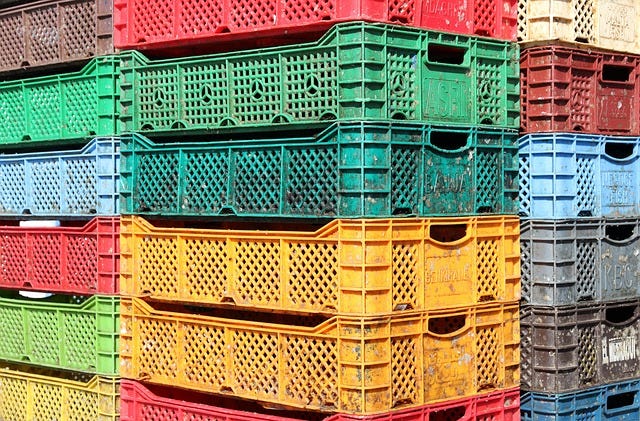
She ushered me through a side door into another kitchen-like room. Then we walked through a pair of swinging doors into a large, cold warehouse. A small team of workers were busy arranging large plastic crates into neat rows that corresponded with numbers stenciled across the warehouse floor. Their white coats and bouffant caps were fitted snugly over the warm layers of clothing and knit hats they’d wisely worn to work that morning.
“You’ll be working back here with these guys,” she told me. “I don’t think any of them speak English. But they know what they’re doing. Just follow their lead.”
The lady, who had not introduced herself, led me to a small room on the other side of the warehouse and showed me how to punch in on the time clock. Our work day was from 8:00am to 2:00pm with lunch at 11:00. Under no circumstances were we to exceed our six-hour shift.
Then she brought me to a small row of carts and a stack of boxes near the loading dock. The boxes were filled with frozen foods in colored packages–yellow breakfast sandwiches, green burritos, red pizza puffs. I was to cut open a box, dump the contents into my cart, and then, according to a list inside the box, distribute the foods into the numbered crates that now lined the warehouse floor. Once filled, the crates would be delivered to local convenience stores.
The workers had begun distribution, deftly slicing boxes, dumping the contents into their heavy carts, and sailing across the warehouse flinging frozen burritos into crates.
I looked at my watch: 8:15. I had been in the warehouse for 10 minutes, and I was already shivering uncontrollably in my summer dress. The thin, canvas Mary Janes I’d bought for $5 in Chinatown did nothing to insulate my feet from the icy floor.
I hope Dad’s happy, I thought bitterly. My job at the pharmacy wasn’t miserable enough for him. So now I’m wearing a shower cap and working in a freezer for half the pay, and it’s still part-time. Great.
I sighed and grabbed a cart. A head taller, several shades paler, and the only woman among the workers, they eyed me with curiosity. But they greeted me with a polite “Buenos días.”
“Buenos días,” I echoed. I had taken French in high school and barely knew a word of Spanish. Either way, there was no time for chit chat. The faster we moved, the warmer we stayed–or, at least the easier it was to forget the cold. I tried to thaw out during bathroom breaks. I ran my bluish hands under the hot water until they turned pink again and let the heat of the hand dryer warm me until I stopped shivering.
At 11, we filtered out to the parking lot for our 20-minute lunch break. We peeled off our layers and let the sun soak into our skin. Several guys hoisted themselves onto the expansive hood of a big, yellow car whose rust spots gave it the appearance of an overripe banana. Following their lead, I climbed onto the hood of my car. The guys ate tamales and laughed and joked in Spanish. I ate my salami sandwich with iceberg lettuce in silence and studied the clouds. Waves of despair washed over me.
“Hola,” someone said, startling me out of my self-pity. “Soy Diego.” I looked up. A thin guy with dark, wavy hair and coffee brown eyes stood next to my car. I’d noticed him in the warehouse earlier because he was so much taller than the rest of the work crew–almost as tall as me. He stuck out his hand.
“Hola,” I said and shook it, grateful for the company. “Liz.”
He asked me a question in Spanish. I didn’t understand. He tried again. I looked at him blankly.
“No hablas español?”
“No.” I smiled apologetically.
“Ah. No hablo inglés.” He smiled apologetically, revealing straight, white teeth before casting his eyes downward.
Then he looked up at me. “Vuelves mañana?”
“Mañana?” I echoed. It occurred to me that I could leave at the end of the day and never come back. Tomorrow I could go to a new temp agency, maybe one in the neighboring upper-middle-class town of Naperville, and get a full-time administrative temp job making double or even triple what they paid here.
That wasn’t true for Diego. And though I’d only been there a few hours, I saw how hard he and his colleagues worked. For them, this job was an opportunity, not a punishment.
“Sí,” I announced firmly.
“En serio?” he asked dubiously, squinting at me through dark lashes.
“Sí,” I repeated, a little less certain than I’d been the moment before.
The next day, I threw on jeans, a t-shirt, and sneakers and drove back to the industrial park. I was pulling a thick sweater over my head when the big, banana-yellow car pulled into the parking lot. My coworkers spilled out–one, two, three, four, five, six, seven of them–and pulled hoodies and jackets from the trunk.
“Buenos días!” they called to me as they layered up.
“Buenos días!” I called back.
The work was uncomfortable and mind-numbing. And the language barrier made for a lonely workday. But the job was more tolerable in proper attire. I sailed through the warehouse tossing Hot Pockets into crates and challenging myself to go faster and faster.
As I hoisted myself onto the hood of my car that day for lunch, Diego sauntered over. “Was there room for one more?” he asked with his eyes. I scooted over, and he hopped up.
Having few options for conversation, we indulged in a vocabulary lesson. “¿Cómo se dice coche?” he would say, patting my car.
“Car!” I’d say. And then, “¿Es…coche?”
“Sí!” he’d nod vigorously.
“¿Cómo se dice sky?” I’d ask, pointing upward.
We discussed the sun, the building, my sandwich, his tamale, our jeans, our shoes, the nearby tree. When we ran out of objects, we munched my carrots in silence until it was time to go in.
The next day, we continued our vocabulary lesson with the objects in our lunches and my purse.
When we once again ran out of words, Diego looked at me shyly. “¿Tienes novio?” he asked.
“Sorry, no comprendo,” I said apologetically.
“Amor,” he said, drawing a heart with his fingers.
Ugh. Why did everything always have to lead here? I hoped my face did not reveal my annoyance.
“Ah. Sí,” I said truthfully. “I have a boyfriend. A…novio?”
“Oh.”
Diego’s face fell. My irritation grew. We had literally nothing in common, not even language. What real interest could he possibly have in me as a person? But, not wanting to alienate the only friend I had in this place, I politely continued the conversation.
“How about you?” I asked Diego, pointing at him.
“Yes,” he said haltingly. “I have boyfriend.”
I smiled in spite of myself, fairly certain he had intended to say he had a girlfriend. But I knew how to find out.
“Do you have a picture?” I asked. Diego looked at me blankly, and for the first time, I noticed the stray freckles that dotted his creamy skin. “A photo,” I tried again. He shook his head, unsure what I was trying to ask.
“Ah,” I said, holding up a finger. “Un momento.” I rustled through my purse and again slid my license from my wallet. “A photo,” I said, pointing at the picture on my ID. “Do you have a photo of your, um, boyfriend? Your novio?” I asked.
“Ah,” he said. “Mañana. ¿Y tú? ¿Tienes una foto de tu novio?”
“Mañana,” I promised.
Diego plucked my ID from my hand and studied the picture. “Muy bonita,” he said, blushing, and handed it back to me.
I cringed. Hadn’t he just heard me say I had a novio? Diego reached for his pocket and pulled out a small stack of cards and bills. He shuffled through them, slid one of several IDs from the pile, and handed it to me. Though I had assumed he was older than me–for no other reason than that I was a student and he was not–his ID said he was 19, like me. Diego looked at me expectantly.
“Oh,” I said lamely. I was not about to encourage him by telling him his photo was “bonito.”
Luckily, lunch was over. I gave Diego his ID and slid down from my car. Time to bundle up for round two.
At the end of our shift, we swarmed into the small back room and hurried to punch the time clock by 2:00–a rule I assumed preserved the company’s ability to deny us benefits, overtime, and breaks aside from our short lunch. The names on the time cards did not match the names I heard people call each other. Even Diego’s time card had a different name. I guessed nearly everyone but me was undocumented and using alternate identities to claim eligibility to work. If the ruse was obvious, the organization seemed to look the other way, since people weren’t exactly lining up for this job.
In the coming days, I’d learn in broken lunchtime conversations that, when I went home from our six-hour shift, most of my coworkers went to their second jobs bussing tables and washing dishes at nearby restaurants. Some then went to third jobs. They shared an apartment nearby and sent most of their scant wages home to their families in Mexico.
It was Thursday when Brandy appeared–the only other American-born English speaker since my Monday arrival. Unlike me, she dressed appropriately for work on her first day: heavy sweats; sneakers; long, burgundy hair pulled into a ponytail and stuffed into a bouffant cap. As the lady briskly showed her around the warehouse, Brandy ambled after her, the open Red Bull in her hand evidently not having any effect.
After the tour, the lady led her over to me. “This is Brandy,” she announced, as if bestowing me with a gift. Brandy rolled her eyes and dug her hand into her pocket, fidgeting with the pack of cigarettes there. “Would you mind answering any questions she has today?”
I smiled at Brandy. She scowled. “How often do we get a smoke break?” she asked the lady, her voice husky and worn. I felt like I was back in high school, the rule-following overachiever paired on a group project with the world-weary rebel who knew better than to participate in this bullshit.
“It’s a six-hour shift,” said the lady,” so you get a 20-minute lunch break. That’s it.”
“That’s bullshit,” said Brandy. She finally looked at me. “Fucking bullshit,” she repeated.
It was bullshit. But I couldn’t wait to get away from her. A few yards away, our coworkers had laid out all the crates and were grabbing carts and cutting open boxes. Diego saw me and waved. “I’ve gotta go punch in,” I said, backing away from Brandy and the lady.
“I’ve gotta finish my breakfast,” said Brandy, holding up her energy drink and patting the pack of cigarettes in her pocket. She started toward the heavy door that led to the parking lot.
The din of the warehouse drowned out my sigh. All week I’d been longing for another English speaker. Now the old adage ran through my mind: Be careful what you wish for. I sliced open a box and dumped its frozen contents into my cart, working quickly to stay warm. After finishing her breakfast cigarette, Brandy grabbed a cart and trundled around the warehouse, halfheartedly tossing frozen goods into bins without so much as a glance at her paper list.
Now, 15 minutes after the official end of our uncomfortable lunch break, Brandy re-entered the warehouse with a scowl. The lady was waiting for her at the door. Out of the corner of my eye, I saw the lady point first to the clock on the wall and then to the list in her hand. She gestured to the bins. Brandy jabbed her finger toward one of the other workers with a sneer. The lady shook her head and said something. Brandy threw her hands in the air and said something back. The lady shook her head. Brandy tore off her cap and coat and shoved them at the lady. Then she turned on her heel, pushed open the heavy door, and disappeared into the white sunlight. The other workers and I exchanged glances, our lips curling into subtle smiles.
The next week, another American-born worker showed up one day but failed to return the next. I stayed for three weeks before tapping into my privilege to find a much better paying office job in Naperville that would allow me to save money for school. I felt guilty as I said goodbye to Diego and the others on my last day. But as I tore off my bouffant cap, handed in my white coat, and walked through the heavy door for the last time, the warm sunshine melted any heaviness I felt about our inequity into a self-indulgent relief far out of reach for my coworkers.
I don’t remember much of what I learned in my college classes that year. But I do remember my time in that freezing warehouse. The cold wore down our bodies. The work was both taxing and numbing. The pay was too low for anyone to live on. No one who worked there was stealing American jobs. They were doing something I’d never had to do–making a way out of no way.
My coworkers were not draining America’s resources. They were providing America’s resources. And working with them helped my young eyes see America more clearly.
I love the narrative here about the struggles of real people and the attitude of privilege vs, the non privileged. Thanks for sharing what people know but won’t talk about . Love this article .
They weren't stealing American jobs back then, and they are not stealing them today.